The Raised Bed Detail Most Gardeners Get Wrong (And Why Bed Height Isn’t the Same as Root Depth)
The Raised Bed Detail Most Gardeners Get Wrong (And Why Bed Height Isn’t the Same as Root Depth)
Jan 5, 2026
If you’ve ever built raised beds, you’ve probably made this assumption:
Taller beds mean deeper roots.
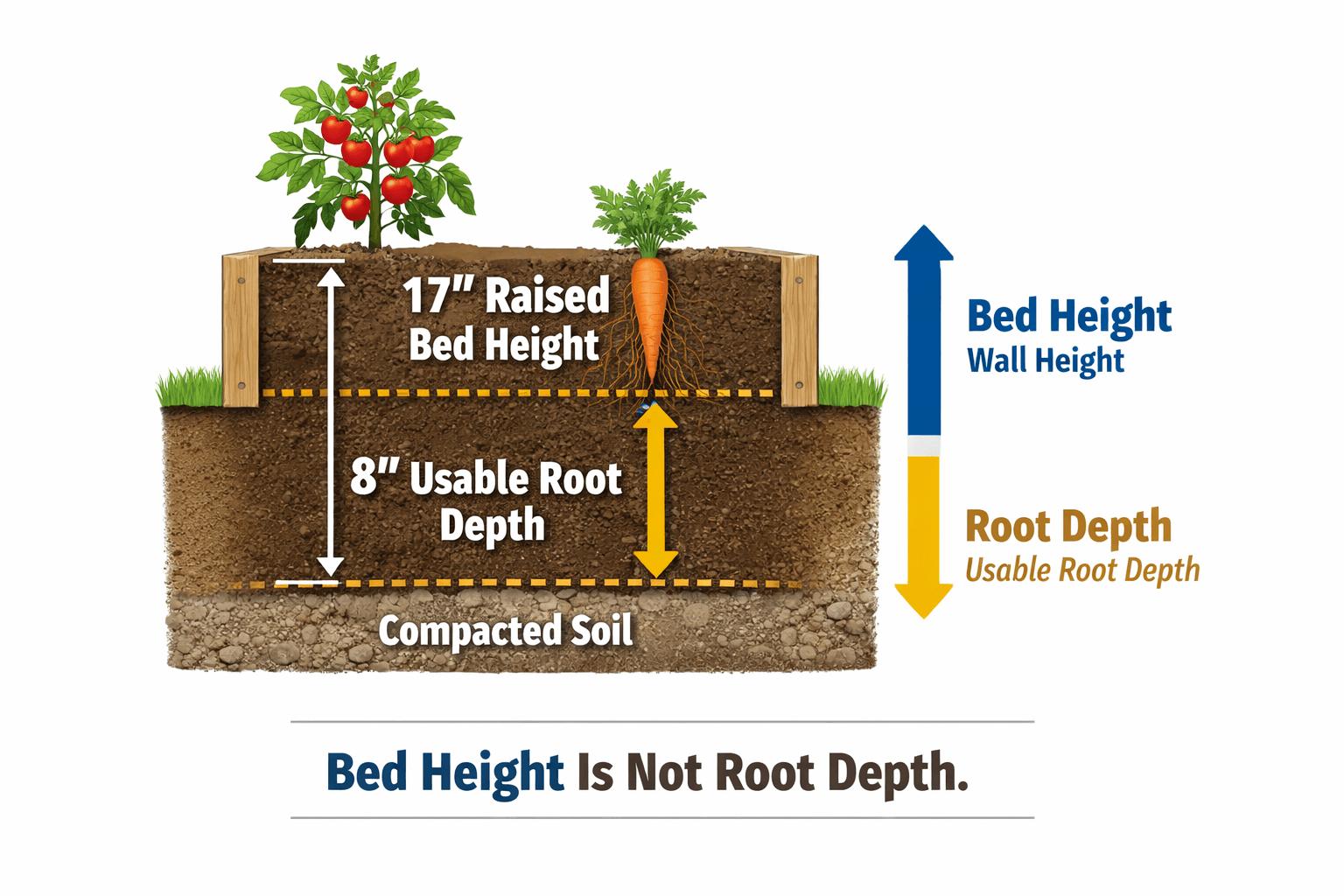
It feels logical. A 17-inch raised bed should give plants 17 inches of root space, right?
But that assumption is one of the most common — and costly — planning mistakes gardeners make. Because in real gardens, bed height and usable root depth are often very different things. These are 7 more Raised Bed Gardening Mistakes
And when those two numbers don’t match, yields suffer.
The Garden That Forced Me to Rethink Raised Beds
A few years ago, my raised beds were overflowing with food. Tomatoes, squash, peppers — we were harvesting more than we could keep up with.
At the time, it felt like the system was working perfectly.
Then reality caught up.
Bindweed moved in.
Bermuda grass crept up from underneath.
Root-knot nematodes established themselves in the soil.
Eventually, those beds stopped being productive, and we made the decision to rip everything out and start over.
That rebuild forced me to confront a decision most gardeners struggle with:
How deep should raised beds actually be?
I was torn between rebuilding at about 11 inches or going all the way up to 17 inches — and that’s when I realized something important.
Bed Height Is Not Root Depth
A 17-inch raised bed does not automatically give you 17 inches of root space.
In a lot of gardens, the number you think you have isn’t even close to the number plants are actually using.
Why?
Because plants don’t care how tall the sides of your bed are.
They respond to usable root depth.
Usable root depth is how far roots can grow before they hit resistance, compaction, or oxygen loss.
And in most backyards, that depth is limited by things you don’t see from the surface.
The Five Scenarios That Limit Root Depth
Most gardeners don’t realize which situation they’re dealing with — because the problem is underground.
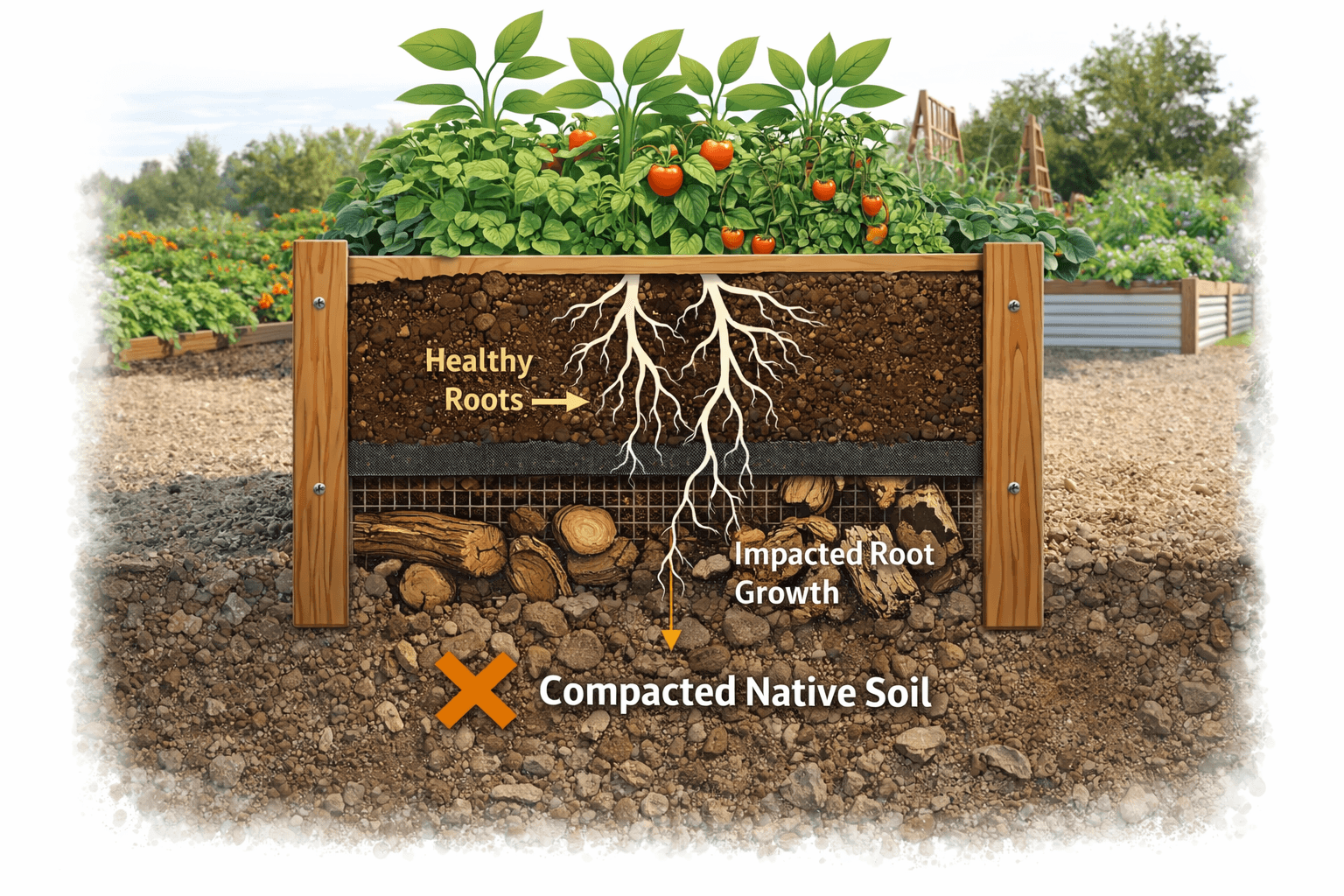
1. Compacted Native Soil
In many yards, the soil beneath a raised bed isn’t really soil at all.
It may be construction fill, heavy clay, or ground that’s been compacted by equipment, foot traffic, or years of mowing. In some cases, there’s even a concrete slab underneath.
Even if the soil inside the bed looks loose and healthy, roots can hit that dense layer below and stop.
From above, plants look fine.
Below the surface, the root system is shallow and compressed.
That limits water access, nutrient uptake, and resilience during heat or dry spells.
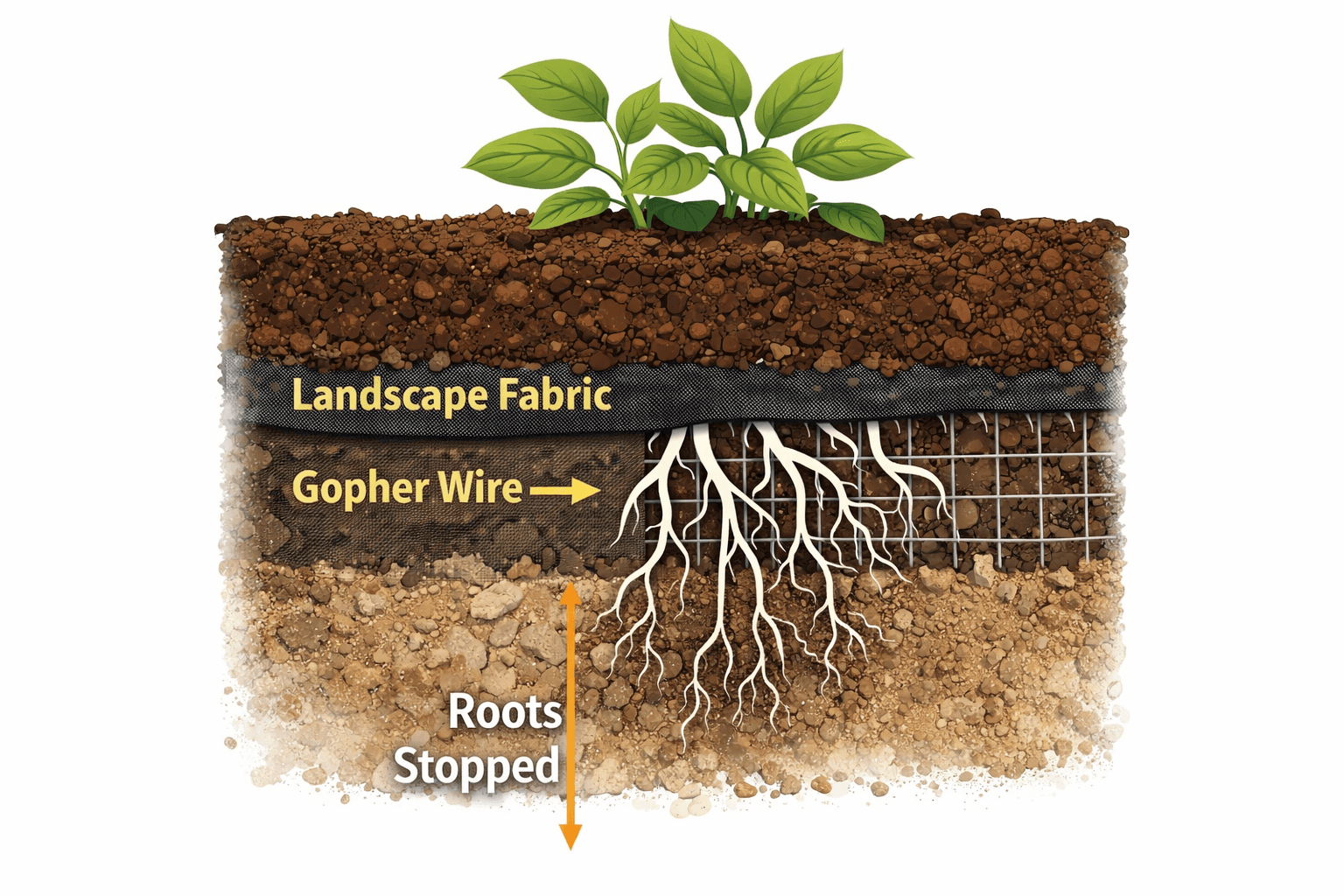
2. Artificial Barriers
Another common issue is artificial barriers placed between the raised bed and native soil:
Cardboard
Landscape fabric
Gopher wire
These are usually added with good intentions — weed control or pest prevention — but many of them act like a wall to roots.
Water may move through, but roots often don’t.
In the case of gopher wire, long-rooted crops like carrots can simply run out of depth.
Instead of growing downward, roots spread sideways, circle, and stall.
3. Poor Drainage and Oxygen Loss
Roots don’t just need depth — they need oxygen.
In soils with poor drainage, water fills the pore space and pushes oxygen out. Once that happens, roots stop growing downward.
This is especially common in clay-heavy soils or areas with a high water table.
Everything looks normal from above, but below the surface, roots are confined to a thin oxygenated layer near the top of the bed. Read this University extension article on soil compaction and root growth
4. Hügelculture and Unfinished Fill Material
Another situation that limits usable root depth is what’s inside the bed — not underneath it.
Many taller raised beds are partially filled with large organic material to save on soil costs:
Logs
Branches
Sticks
Wood chips
Coarse debris
Kitchen scraps
This is often done intentionally using hügelculture, which can work very well over time.
The problem is counting that material as usable root space too early.
Until it breaks down, unfinished organic material doesn’t behave like soil. It creates air gaps, uneven moisture zones, and physical voids that roots won’t reliably penetrate.
So even though the bed looks deep, the functional planting zone may only be the top layer of finished soil.
If the bottom half of your bed isn’t really soil yet, your bed isn’t really that deep yet.
As that material breaks down, beds can also settle dramatically, reducing depth even further if they aren’t topped up regularly.
5. Time and Settling
Even when everything starts out perfect, time changes the equation.
Organic matter breaks down.
Air pockets collapse.
Soil settles.
What began as a deep, loose planting zone gradually becomes shallower.
If beds aren’t topped up each season, usable root depth slowly decreases year after year — which is why beds that “used to work” often stop performing.
The Rule Most Gardeners Never Factor In
Once you understand these scenarios, one simple rule starts to make sense:
If the soil underneath your bed is compacted, you get less root space than the bed height suggests.
If the soil underneath your bed is good, you can actually get more root space than the bed height suggests.
This is the detail most raised bed advice leaves out.
Why Plants Look Healthy but Don’t Produce
This explains a frustratingly common experience.
Plants look healthy.
They grow tall.
They leaf out.
But yields are disappointing.
Fruit is smaller.
Production drops off early.
That’s not fertilizer.
It’s not variety.
That’s root confinement.
Tomatoes, for example, need about 12–18 inches of loose, oxygenated soil for peak production. When they don’t get it, they adapt — but not in a good way. Read our article on Why Tomatoes Fail Even When Plants Look Healthy
Big plants.
Fewer flowers.
Earlier burnout.
The plant wasn’t wrong.
The planning was.
What This Means for Bed Height (11 Inches vs. 17 Inches)
An 11-inch bed can absolutely work.
It’s enough for most carrots, enough for teepee poles, and enough for many crops — as long as that depth is truly usable and well maintained.
But shallow beds leave less margin for error. Settling, barriers, or compaction show up faster.
A 17-inch bed buys margin and forgiveness, especially where native soil or drainage is poor — but it comes with higher cost and a greater temptation to overfill with unfinished material.
Taller beds reduce risk.
They don’t remove it.
The Real Planning Fix
The key takeaway isn’t a specific number.
It’s this:
You don’t choose bed height first.
You choose required root depth first.
Then you decide how to achieve it:
Improve the soil underneath
Increase bed height and fill it with quality material
Or plan crops that match the depth you actually have
That’s real planning — and it’s the difference between beds that look good and beds that produce year after year. Read about the 15 Best Vegetables to Grow in Raised Beds
If you’ve ever built raised beds, you’ve probably made this assumption:
Taller beds mean deeper roots.
It feels logical. A 17-inch raised bed should give plants 17 inches of root space, right?
But that assumption is one of the most common — and costly — planning mistakes gardeners make. Because in real gardens, bed height and usable root depth are often very different things. These are 7 more Raised Bed Gardening Mistakes
And when those two numbers don’t match, yields suffer.
The Garden That Forced Me to Rethink Raised Beds
A few years ago, my raised beds were overflowing with food. Tomatoes, squash, peppers — we were harvesting more than we could keep up with.
At the time, it felt like the system was working perfectly.
Then reality caught up.
Bindweed moved in.
Bermuda grass crept up from underneath.
Root-knot nematodes established themselves in the soil.
Eventually, those beds stopped being productive, and we made the decision to rip everything out and start over.
That rebuild forced me to confront a decision most gardeners struggle with:
How deep should raised beds actually be?
I was torn between rebuilding at about 11 inches or going all the way up to 17 inches — and that’s when I realized something important.
Bed Height Is Not Root Depth
A 17-inch raised bed does not automatically give you 17 inches of root space.
In a lot of gardens, the number you think you have isn’t even close to the number plants are actually using.
Why?
Because plants don’t care how tall the sides of your bed are.
They respond to usable root depth.
Usable root depth is how far roots can grow before they hit resistance, compaction, or oxygen loss.
And in most backyards, that depth is limited by things you don’t see from the surface.
The Five Scenarios That Limit Root Depth
Most gardeners don’t realize which situation they’re dealing with — because the problem is underground.
1. Compacted Native Soil
In many yards, the soil beneath a raised bed isn’t really soil at all.
It may be construction fill, heavy clay, or ground that’s been compacted by equipment, foot traffic, or years of mowing. In some cases, there’s even a concrete slab underneath.
Even if the soil inside the bed looks loose and healthy, roots can hit that dense layer below and stop.
From above, plants look fine.
Below the surface, the root system is shallow and compressed.
That limits water access, nutrient uptake, and resilience during heat or dry spells.
2. Artificial Barriers
Another common issue is artificial barriers placed between the raised bed and native soil:
Cardboard
Landscape fabric
Gopher wire
These are usually added with good intentions — weed control or pest prevention — but many of them act like a wall to roots.
Water may move through, but roots often don’t.
In the case of gopher wire, long-rooted crops like carrots can simply run out of depth.
Instead of growing downward, roots spread sideways, circle, and stall.
3. Poor Drainage and Oxygen Loss
Roots don’t just need depth — they need oxygen.
In soils with poor drainage, water fills the pore space and pushes oxygen out. Once that happens, roots stop growing downward.
This is especially common in clay-heavy soils or areas with a high water table.
Everything looks normal from above, but below the surface, roots are confined to a thin oxygenated layer near the top of the bed. Read this University extension article on soil compaction and root growth
4. Hügelculture and Unfinished Fill Material
Another situation that limits usable root depth is what’s inside the bed — not underneath it.
Many taller raised beds are partially filled with large organic material to save on soil costs:
Logs
Branches
Sticks
Wood chips
Coarse debris
Kitchen scraps
This is often done intentionally using hügelculture, which can work very well over time.
The problem is counting that material as usable root space too early.
Until it breaks down, unfinished organic material doesn’t behave like soil. It creates air gaps, uneven moisture zones, and physical voids that roots won’t reliably penetrate.
So even though the bed looks deep, the functional planting zone may only be the top layer of finished soil.
If the bottom half of your bed isn’t really soil yet, your bed isn’t really that deep yet.
As that material breaks down, beds can also settle dramatically, reducing depth even further if they aren’t topped up regularly.
5. Time and Settling
Even when everything starts out perfect, time changes the equation.
Organic matter breaks down.
Air pockets collapse.
Soil settles.
What began as a deep, loose planting zone gradually becomes shallower.
If beds aren’t topped up each season, usable root depth slowly decreases year after year — which is why beds that “used to work” often stop performing.
The Rule Most Gardeners Never Factor In
Once you understand these scenarios, one simple rule starts to make sense:
If the soil underneath your bed is compacted, you get less root space than the bed height suggests.
If the soil underneath your bed is good, you can actually get more root space than the bed height suggests.
This is the detail most raised bed advice leaves out.
Why Plants Look Healthy but Don’t Produce
This explains a frustratingly common experience.
Plants look healthy.
They grow tall.
They leaf out.
But yields are disappointing.
Fruit is smaller.
Production drops off early.
That’s not fertilizer.
It’s not variety.
That’s root confinement.
Tomatoes, for example, need about 12–18 inches of loose, oxygenated soil for peak production. When they don’t get it, they adapt — but not in a good way. Read our article on Why Tomatoes Fail Even When Plants Look Healthy
Big plants.
Fewer flowers.
Earlier burnout.
The plant wasn’t wrong.
The planning was.
What This Means for Bed Height (11 Inches vs. 17 Inches)
An 11-inch bed can absolutely work.
It’s enough for most carrots, enough for teepee poles, and enough for many crops — as long as that depth is truly usable and well maintained.
But shallow beds leave less margin for error. Settling, barriers, or compaction show up faster.
A 17-inch bed buys margin and forgiveness, especially where native soil or drainage is poor — but it comes with higher cost and a greater temptation to overfill with unfinished material.
Taller beds reduce risk.
They don’t remove it.
The Real Planning Fix
The key takeaway isn’t a specific number.
It’s this:
You don’t choose bed height first.
You choose required root depth first.
Then you decide how to achieve it:
Improve the soil underneath
Increase bed height and fill it with quality material
Or plan crops that match the depth you actually have
That’s real planning — and it’s the difference between beds that look good and beds that produce year after year. Read about the 15 Best Vegetables to Grow in Raised Beds
Free Weekly Garden Tips
Join my free newsletter to receive weekly garden insights + things I think you'll find interesting!
Free Weekly Garden Tips
Join my free newsletter to receive weekly garden insights + things I think you'll find interesting!
Free Weekly Garden Tips
Join my free newsletter to receive weekly garden insights + things I think you'll find interesting!
Let's grow your dream garden.

Subscribe
Join our newsletter to stay up to date on everything happening!
By subscribing you agree to our Privacy Policy and provide consent to receive updates from our company.
Let's grow your dream garden.
Subscribe
Join our newsletter to stay up to date on everything happening!
By subscribing you agree to our Privacy Policy and provide consent to receive updates from our company.
Let's grow your dream garden.
Subscribe
Join our newsletter to stay up to date on everything happening!
By subscribing you agree to our Privacy Policy and provide consent to receive updates from our company.