Why Indoor Seed Starting Fails
Why Indoor Seed Starting Fails
Jan 12, 2026
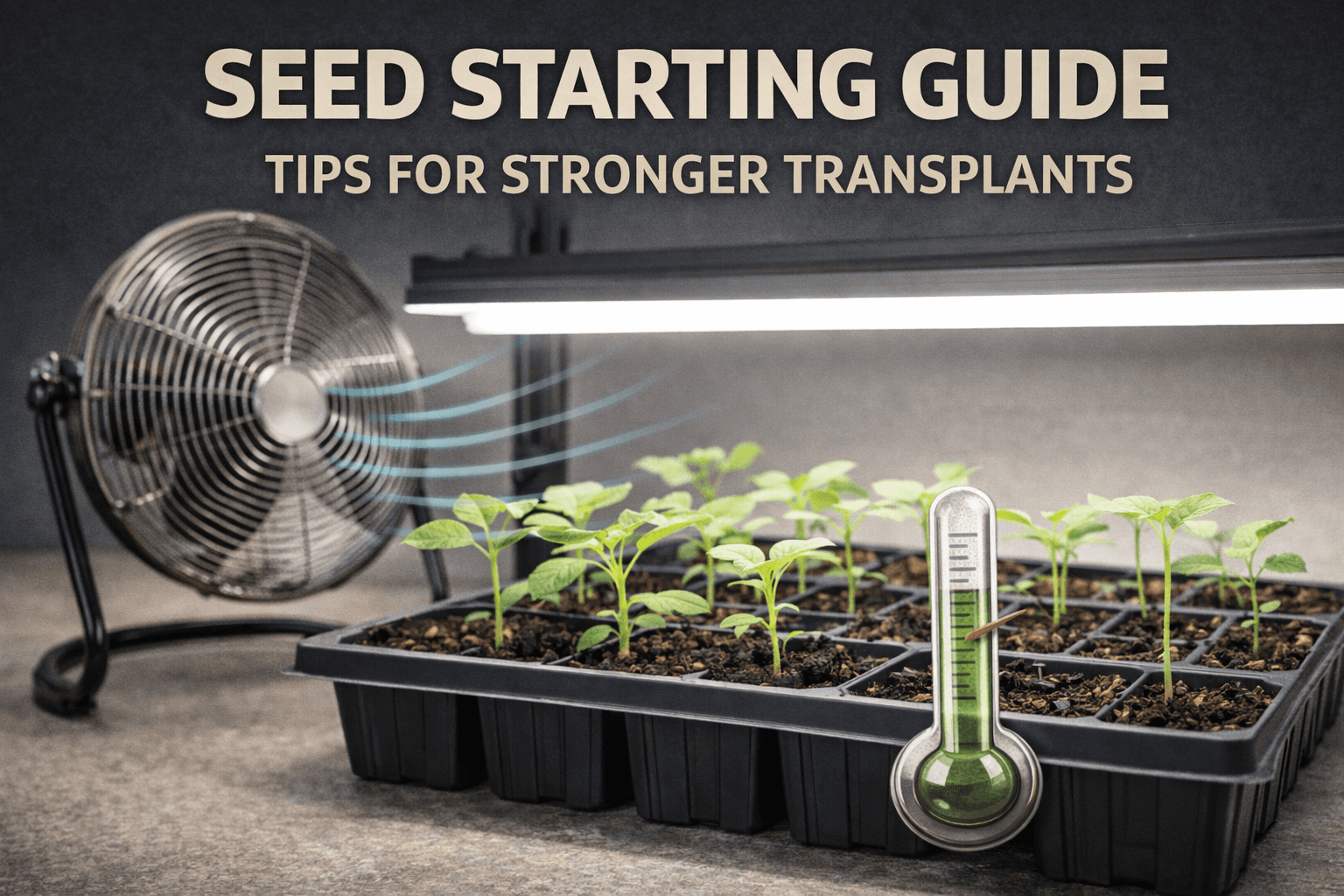
Most indoor seed-starting failures don’t happen because something is missing.
They happen when everything looks right — but growth never really syncs up.
Seeds germinate.
Seedlings stay green.
Nothing looks obviously wrong.
And yet…
Growth slows.
Plants stall.
Or they struggle later in the garden for reasons no checklist ever explains.
That’s because indoor seed starting doesn’t fail when one ingredient is missing.
It fails when light, temperature, moisture, airflow, and timing drift slightly out of alignment.
When that happens, seedlings don’t crash.
They keep growing — just slower than they should.
And slow growth is the most misleading failure mode in seed starting.
Once you understand how these conditions fall out of sync — and how to spot it early — indoor seed starting becomes far more predictable.
The Mistakes Most Gardeners Blame (And Why They’re Usually Wrong)
When seedlings underperform, most gardeners assume the cause is obvious:
Bad seeds
Cheap soil
Weak grow lights
So they upgrade brands.
They add equipment.
They change products.
But when you actually troubleshoot failed seedlings, the setup usually looks fine:
Lights are on
Soil is moist
Leaves are green
Nothing looks wrong.
And that’s the problem.
Indoor seed starting rarely fails because of one big mistake.
It fails because several small mismatches stack together.
Each one seems harmless on its own.
Together, they quietly limit root growth, energy, or timing — until the plant never builds momentum.
Why This Approach Is Different
Instead of listing more products or setups, this guide focuses on the invisible failures most people don’t talk about.
These aren’t things you see in photos.
They’re things you notice only when you watch growth over time.
Once you understand them, seed starting stops feeling mysterious — and starts feeling controllable.
Failure #1: Roots Hit a Wall Too Early
The first failure happens underground — long before you notice a problem above it.
Most seedlings outgrow their containers long before they look big enough to transplant.
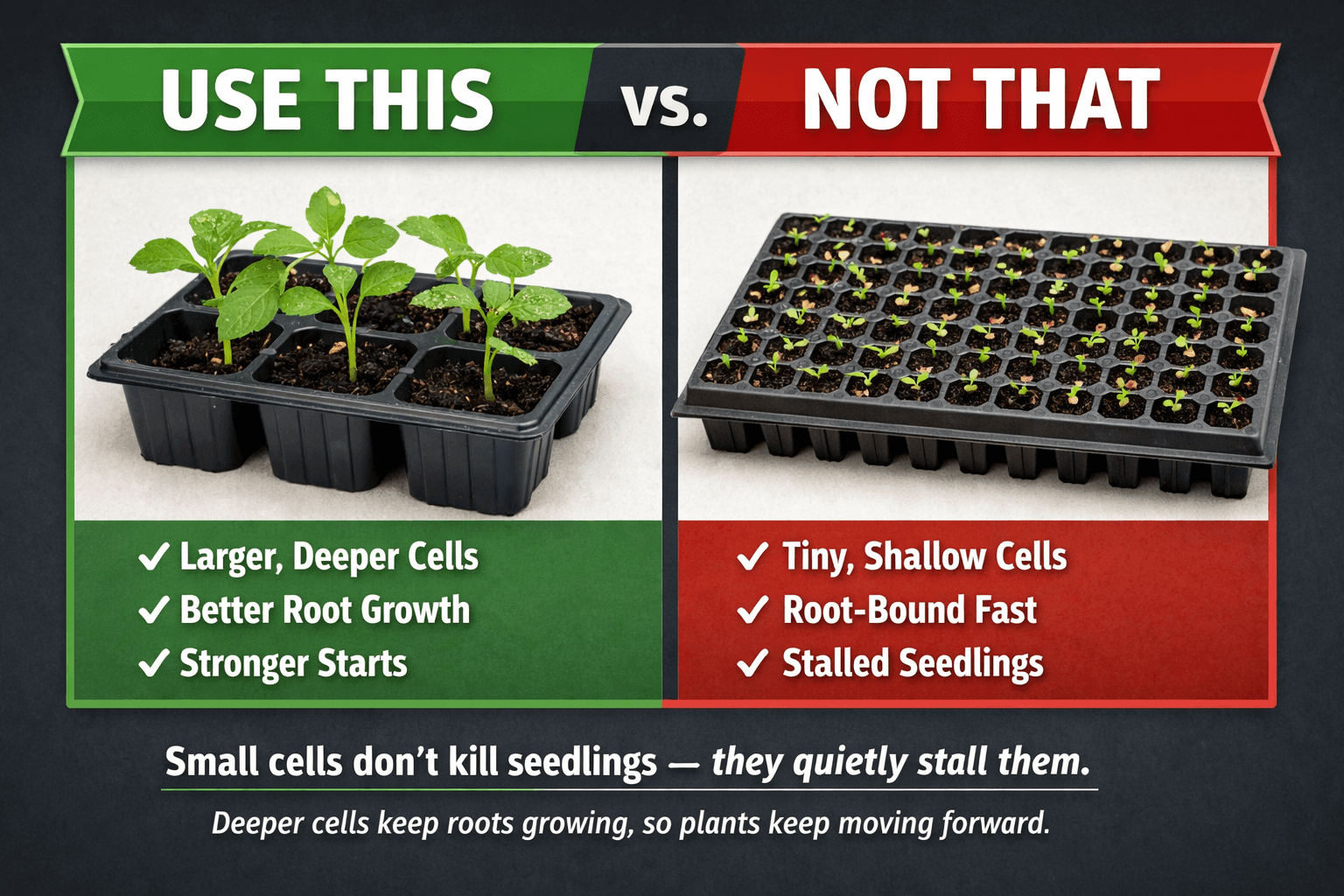
This is especially common in small cells like 72-cell trays or smaller.
Those trays are designed to start seeds — not to grow seedlings to transplant size.
A quick reality check is to compare your seedlings to what you buy at the garden center.
Garden-center transplants aren’t grown in tiny cells.
They’re grown in deeper plugs or small pots, intentionally.
Those plants need to keep growing for weeks — through shipping, handling, and bench time — without stalling.
When you start seeds in very small cells at home, that window is much shorter.
Roots hit the bottom fast.
And once roots stall, the plant slows growth on purpose — even if the leaves still look healthy.
This creates one of the most misleading situations in seed starting:
Seedlings that look fine… but aren’t actually progressing.
They aren’t stressed.
They aren’t dying.
They’re just stuck.
The rule:
If roots stall, the plant stalls — no matter how good your light is.
You can’t out-light a root-bound seedling.
Early root restriction doesn’t just pause growth.
It affects how that plant performs for the rest of the season.
The fix:
Up-pot earlier — or start in containers that allow real root depth, not just surface growth.
Failure #2: Light That Maintains — But Doesn’t Build
Most indoor setups have enough light to keep seedlings alive and upright.
That’s not the same as having enough light to build energy.
Seedlings need light to:
Grow roots
Thicken stems
Store energy for transplant
When light is borderline, plants go into conservation mode.
What you get are short, green seedlings that never gain momentum.
Here’s the important part:
In most cases, the fix is not buying a stronger light.
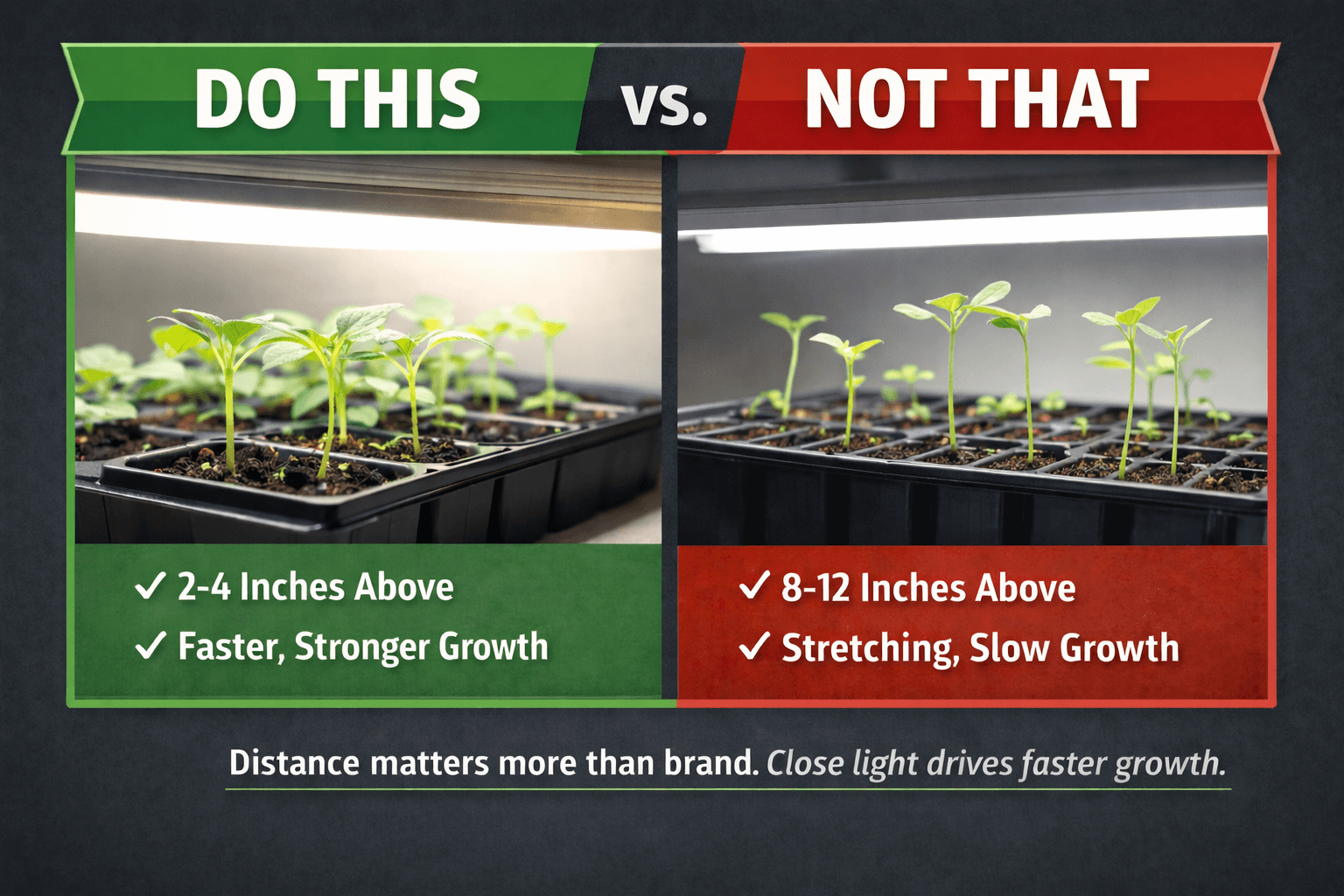
Light intensity drops rapidly with distance.
Distance matters more than brand.
Moving seedlings just a few inches closer to the light can dramatically increase intensity. Of course, this isn't necessary if you have a professional grow light, but if not, watch the distance.
If seedlings look fine but barely change week to week, bring them closer — close enough to drive growth, but not so close that heat becomes an issue.
The rule:
If growth is slow indoors, the plant is conserving energy — not thriving.
Healthy seedlings should visibly change every few days.
If nothing is changing, light intensity is usually the limiter.
Failure #3: Temperature Is Right for You — Not the Roots
This is the one almost nobody checks.
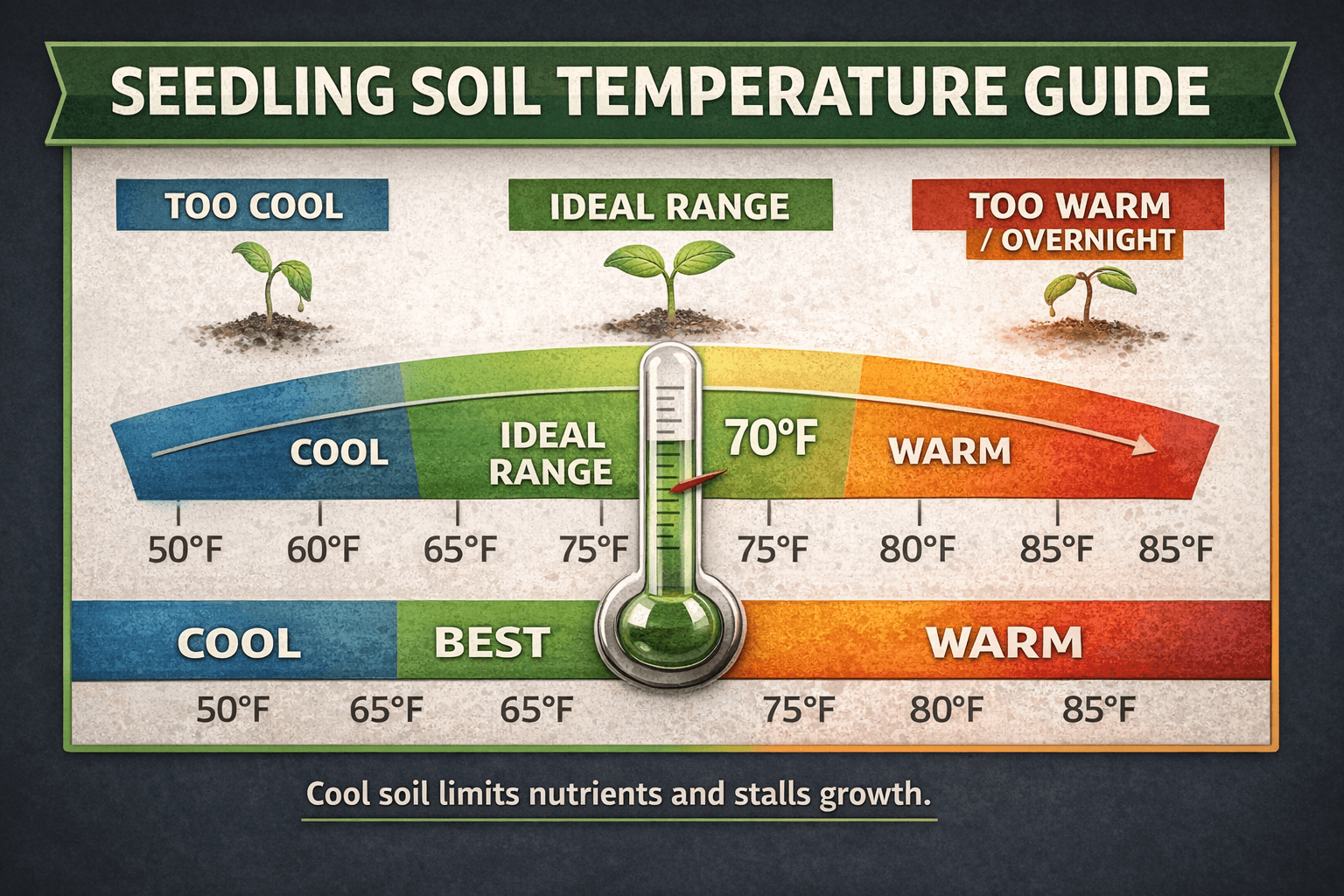
Seed packets list germination temperatures, but seedling growth temperatures matter just as much.
Most homes are cooler at soil level than people realize — especially at night.
That means you can have:
Warm leaves
Cool roots
At the same time.
Cool roots slow nutrient uptake even when everything else looks perfect.
The plant isn’t struggling.
It’s being cautious.
The rule:
Warm leaves + cool roots = stalled seedlings.
The fix:
Use bottom heat early to establish root systems — then remove it once growth is steady. You can do this with a thermostat-adjustable seed mat, the top of an appliance, or a windowsill above a radiator.
Bottom heat is a tool, not something seedlings need forever.
University research shows that soil temperature plays a critical role in early root development, which is explained in more detail here.: go.ncsu.edu/readext?936436
Failure #4: No Airflow, No Strength
In nature, seedlings experience movement from day one.
Wind:
Strengthens stems
Improves gas exchange
Signals the plant to build structure
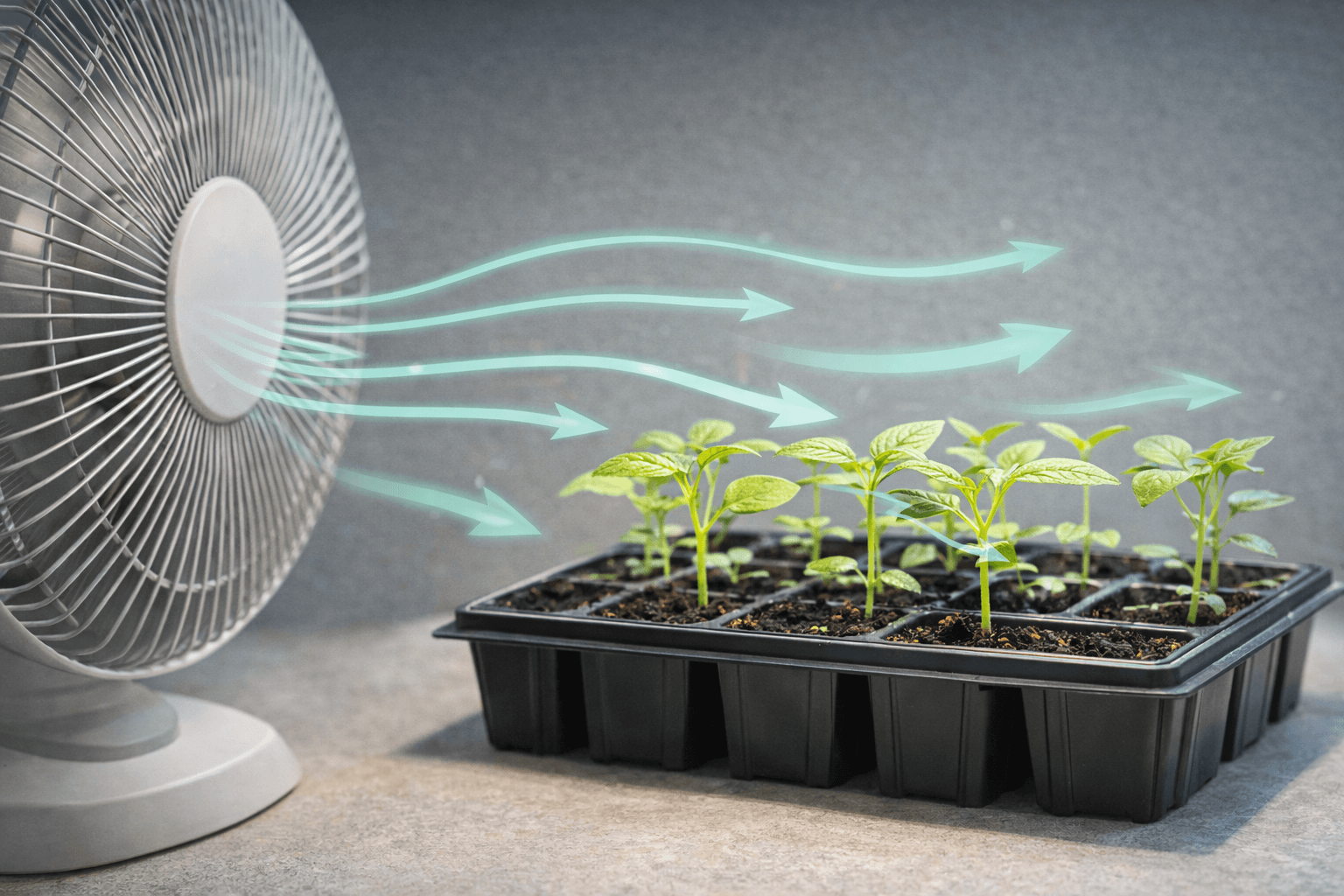
Indoors, seedlings often live in still air.
That leads to weaker stems and plants that struggle the moment conditions change.
The fix doesn’t need to be fancy.
An old oscillating fan in the room is usually enough.
You don’t want constant wind or anything blasting the plants — just gentle, regular movement that causes the leaves to lightly move.
The rule:
No movement equals no strength.
Airflow isn’t just about disease prevention.
It’s about preparing the plant for the real world.
Failure #5: Timing Doesn’t Match Your Real Season
This is the failure that ruins otherwise perfect setups.
Starting seeds “on time” doesn’t matter if your transplant window doesn’t line up.
When seedlings outgrow their containers before outdoor conditions are ready, they stall indoors.
And stalled seedlings rarely recover completely.
Indoor time is borrowed time.
Once seedlings stall indoors, they don’t just pause — their development shifts:
Roots thicken instead of expanding
Growth nodes tighten
Energy storage changes
So even when transplanted later into perfect soil and weather, those plants often underperform.
That’s why two seedlings from the same packet can produce very differently.
One keeps moving forward.
The other waits too long.
And waiting is almost always invisible until mid-season.
This is where planning matters more than equipment.
Instead of counting weeks forward, you have to plan backward from your real transplant window.
Tools that align start dates with actual transplant conditions — including free planning tools like GardenGuide — help seedlings peak at the right moment.
The goal isn’t bigger seedlings.
The goal is timed seedlings.
How These Failures Stack
Any one of these issues alone might not kill a seedling.
But stack:
Shallow roots
Borderline light
Cool soil
No airflow
Poor timing
And the plant never builds momentum.
Everything looks fine.
Nothing is actually right.
The Real Fix: Change the Constraints
If your seedlings look healthy but never really take off, stop changing products.
Change the constraints.
Indoor seed starting only works when roots, light, temperature, airflow, and timing move forward together.
When one stalls, everything else slows to match it.
But when they’re in sync, seedlings don’t just survive indoors — they carry momentum straight into the garden.
That’s how you avoid invisible failures…
and grow seedlings that actually perform all season.
For further info, you can download our Printable PDF. or watch the video below!
Most indoor seed-starting failures don’t happen because something is missing.
They happen when everything looks right — but growth never really syncs up.
Seeds germinate.
Seedlings stay green.
Nothing looks obviously wrong.
And yet…
Growth slows.
Plants stall.
Or they struggle later in the garden for reasons no checklist ever explains.
That’s because indoor seed starting doesn’t fail when one ingredient is missing.
It fails when light, temperature, moisture, airflow, and timing drift slightly out of alignment.
When that happens, seedlings don’t crash.
They keep growing — just slower than they should.
And slow growth is the most misleading failure mode in seed starting.
Once you understand how these conditions fall out of sync — and how to spot it early — indoor seed starting becomes far more predictable.
The Mistakes Most Gardeners Blame (And Why They’re Usually Wrong)
When seedlings underperform, most gardeners assume the cause is obvious:
Bad seeds
Cheap soil
Weak grow lights
So they upgrade brands.
They add equipment.
They change products.
But when you actually troubleshoot failed seedlings, the setup usually looks fine:
Lights are on
Soil is moist
Leaves are green
Nothing looks wrong.
And that’s the problem.
Indoor seed starting rarely fails because of one big mistake.
It fails because several small mismatches stack together.
Each one seems harmless on its own.
Together, they quietly limit root growth, energy, or timing — until the plant never builds momentum.
Why This Approach Is Different
Instead of listing more products or setups, this guide focuses on the invisible failures most people don’t talk about.
These aren’t things you see in photos.
They’re things you notice only when you watch growth over time.
Once you understand them, seed starting stops feeling mysterious — and starts feeling controllable.
Failure #1: Roots Hit a Wall Too Early
The first failure happens underground — long before you notice a problem above it.
Most seedlings outgrow their containers long before they look big enough to transplant.
This is especially common in small cells like 72-cell trays or smaller.
Those trays are designed to start seeds — not to grow seedlings to transplant size.
A quick reality check is to compare your seedlings to what you buy at the garden center.
Garden-center transplants aren’t grown in tiny cells.
They’re grown in deeper plugs or small pots, intentionally.
Those plants need to keep growing for weeks — through shipping, handling, and bench time — without stalling.
When you start seeds in very small cells at home, that window is much shorter.
Roots hit the bottom fast.
And once roots stall, the plant slows growth on purpose — even if the leaves still look healthy.
This creates one of the most misleading situations in seed starting:
Seedlings that look fine… but aren’t actually progressing.
They aren’t stressed.
They aren’t dying.
They’re just stuck.
The rule:
If roots stall, the plant stalls — no matter how good your light is.
You can’t out-light a root-bound seedling.
Early root restriction doesn’t just pause growth.
It affects how that plant performs for the rest of the season.
The fix:
Up-pot earlier — or start in containers that allow real root depth, not just surface growth.
Failure #2: Light That Maintains — But Doesn’t Build
Most indoor setups have enough light to keep seedlings alive and upright.
That’s not the same as having enough light to build energy.
Seedlings need light to:
Grow roots
Thicken stems
Store energy for transplant
When light is borderline, plants go into conservation mode.
What you get are short, green seedlings that never gain momentum.
Here’s the important part:
In most cases, the fix is not buying a stronger light.
Light intensity drops rapidly with distance.
Distance matters more than brand.
Moving seedlings just a few inches closer to the light can dramatically increase intensity. Of course, this isn't necessary if you have a professional grow light, but if not, watch the distance.
If seedlings look fine but barely change week to week, bring them closer — close enough to drive growth, but not so close that heat becomes an issue.
The rule:
If growth is slow indoors, the plant is conserving energy — not thriving.
Healthy seedlings should visibly change every few days.
If nothing is changing, light intensity is usually the limiter.
Failure #3: Temperature Is Right for You — Not the Roots
This is the one almost nobody checks.
Seed packets list germination temperatures, but seedling growth temperatures matter just as much.
Most homes are cooler at soil level than people realize — especially at night.
That means you can have:
Warm leaves
Cool roots
At the same time.
Cool roots slow nutrient uptake even when everything else looks perfect.
The plant isn’t struggling.
It’s being cautious.
The rule:
Warm leaves + cool roots = stalled seedlings.
The fix:
Use bottom heat early to establish root systems — then remove it once growth is steady. You can do this with a thermostat-adjustable seed mat, the top of an appliance, or a windowsill above a radiator.
Bottom heat is a tool, not something seedlings need forever.
University research shows that soil temperature plays a critical role in early root development, which is explained in more detail here.: go.ncsu.edu/readext?936436
Failure #4: No Airflow, No Strength
In nature, seedlings experience movement from day one.
Wind:
Strengthens stems
Improves gas exchange
Signals the plant to build structure
Indoors, seedlings often live in still air.
That leads to weaker stems and plants that struggle the moment conditions change.
The fix doesn’t need to be fancy.
An old oscillating fan in the room is usually enough.
You don’t want constant wind or anything blasting the plants — just gentle, regular movement that causes the leaves to lightly move.
The rule:
No movement equals no strength.
Airflow isn’t just about disease prevention.
It’s about preparing the plant for the real world.
Failure #5: Timing Doesn’t Match Your Real Season
This is the failure that ruins otherwise perfect setups.
Starting seeds “on time” doesn’t matter if your transplant window doesn’t line up.
When seedlings outgrow their containers before outdoor conditions are ready, they stall indoors.
And stalled seedlings rarely recover completely.
Indoor time is borrowed time.
Once seedlings stall indoors, they don’t just pause — their development shifts:
Roots thicken instead of expanding
Growth nodes tighten
Energy storage changes
So even when transplanted later into perfect soil and weather, those plants often underperform.
That’s why two seedlings from the same packet can produce very differently.
One keeps moving forward.
The other waits too long.
And waiting is almost always invisible until mid-season.
This is where planning matters more than equipment.
Instead of counting weeks forward, you have to plan backward from your real transplant window.
Tools that align start dates with actual transplant conditions — including free planning tools like GardenGuide — help seedlings peak at the right moment.
The goal isn’t bigger seedlings.
The goal is timed seedlings.
How These Failures Stack
Any one of these issues alone might not kill a seedling.
But stack:
Shallow roots
Borderline light
Cool soil
No airflow
Poor timing
And the plant never builds momentum.
Everything looks fine.
Nothing is actually right.
The Real Fix: Change the Constraints
If your seedlings look healthy but never really take off, stop changing products.
Change the constraints.
Indoor seed starting only works when roots, light, temperature, airflow, and timing move forward together.
When one stalls, everything else slows to match it.
But when they’re in sync, seedlings don’t just survive indoors — they carry momentum straight into the garden.
That’s how you avoid invisible failures…
and grow seedlings that actually perform all season.
For further info, you can download our Printable PDF. or watch the video below!
FREE PDF GUIDE!
Why Indoor Seed Starting Fails
Free Weekly Garden Tips
Join my free newsletter to receive weekly garden insights + things I think you'll find interesting!
Free Weekly Garden Tips
Join my free newsletter to receive weekly garden insights + things I think you'll find interesting!
Free Weekly Garden Tips
Join my free newsletter to receive weekly garden insights + things I think you'll find interesting!
Let's grow your dream garden.

Subscribe
Join our newsletter to stay up to date on everything happening!
By subscribing you agree to our Privacy Policy and provide consent to receive updates from our company.
Let's grow your dream garden.
Subscribe
Join our newsletter to stay up to date on everything happening!
By subscribing you agree to our Privacy Policy and provide consent to receive updates from our company.
Let's grow your dream garden.
Subscribe
Join our newsletter to stay up to date on everything happening!
By subscribing you agree to our Privacy Policy and provide consent to receive updates from our company.